
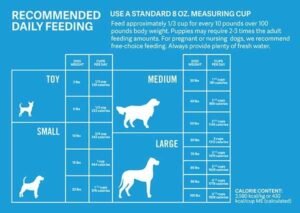
A large dog typically needs 3 to 4 cups of dry food daily, but the exact amount depends entirely on calorie density and activity level.
Large dog feeding amounts
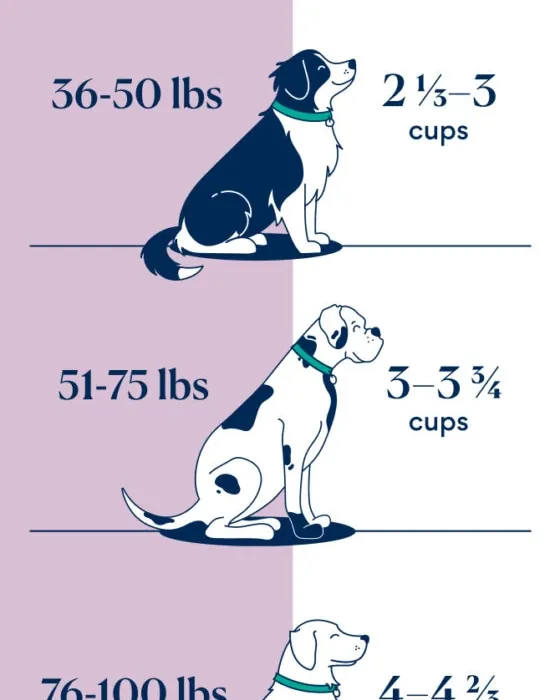
- Active 70-pound dogs usually eat 1,600 to 1,800 calories daily.
- Sedentary or senior large dogs often need only 1,200 to 1,400 calories.
- Puppies require roughly two to three times the calories of an adult dog for growth.
- Food density varies widely; one cup can equal 300 or 500 calories.
- Treats should never exceed 10% of total daily intake.
- Adjust portions weekly based on visible waistline and rib feel.
Why calorie counts matter more
Cup measurements are inconsistent because kibble size and density change between brands. Relying solely on volume leads to accidental overfeeding or underfeeding since a cup of dense food contains significantly more energy than a cup of airy pieces. The National Research Council provides metabolic weight formulas that account for these biological differences better than generic packaging charts.
Metabolic rate isn’t linear with size; larger dogs actually burn fewer calories per pound than smaller ones. This means doubling your dog’s weight doesn’t mean doubling their food. You must calculate based on lean body mass and life stage rather than guessing from previous bags. Individual metabolism varies too, making regular body condition checks essential for finding the true amount your specific dog requires to stay healthy.
When large dog portions change
Standard feeding guides assume an average adult at ideal weight with moderate activity. Real dogs rarely fit this exact profile, requiring adjustments based on their current physical state and lifestyle factors.
| Situation | What changes | What to do instead |
|---|---|---|
| Overweight dog | Lower calorie target needed | Feed for goal weight, not current weight |
| Intact male | Higher metabolic drive | Add 10-20% above neutered guidelines |
| Senior dog | Slower metabolism, less muscle | Reduce calories by 15-20% typically |
| Working dog | High energy expenditure | Double standard ration during heavy work |
| Winter outdoor living | Body heat generation costs | Increase food by 25% in cold months |
How to measure large dog food
- Weigh your dog using a calibrated scale to get an accurate starting baseline.
- Find the calorie content per cup printed clearly on your specific food bag.
- Calculate daily calories needed using your dog’s ideal weight and activity factor.
- Divide total daily calories by the calories-per-cup number listed on packaging.
- Use a digital kitchen scale to weigh out portions instead of measuring cups.
- Split the total weighed amount into two equal meals to prevent bloat.
- Assess body condition score every two weeks by feeling ribs and checking waist.
- Adjust the weighed portion up or down by 10% based on visual assessment results.
Common large dog feeding mistakes
- Free-feeding leaves the bowl full all day, causing rapid weight gain and masking appetite loss that signals illness.
- Using old measuring cups ignores kibble density changes between batches, leading to silent calorie creep over months.
- Ignoring treat calories adds hundreds of uncounted calories daily, undoing precise meal portioning efforts completely.
- Switching foods without recalculating assumes equal density, which is almost never true across different brands or formulas.
- Feeding for current weight instead of ideal weight keeps overweight dogs stuck in a cycle of excess body fat.
Frequently asked questions
Can I feed my large dog once a day?
Feeding twice daily is generally recommended for large breeds to improve digestion and stabilize blood sugar. Splitting meals also stabilizes blood sugar and prevents hunger-related behavior issues. If you must feed once, use a slow-feeder bowl and monitor closely for digestive distress signs.
Why is my large dog always hungry?
Hunger often signals low-calorie food or parasites rather than true need. Check stool quality and consult your vet to rule out medical causes first. If healthy, switch to a higher-protein, fiber-rich formula that promotes satiety without adding empty calories.
How long does a 30lb bag last?
A 30-pound bag lasts about 25 to 30 days for a 70-pound dog eating 3 cups daily. This assumes standard kibble density around 400 calories per cup. Denser foods extend duration while lighter kibbles deplete faster, so track actual consumption weekly.
Is it safe to mix wet and dry food?
Yes, mixing is safe if total daily calories remain within your dog’s calculated limit. Wet food is roughly 75% water, so you must reduce dry kibble proportionally to avoid overfeeding. Introduce gradually over seven days to prevent gastrointestinal upset.
What happens if I overfeed my large dog?
Excess weight stresses joints and shortens lifespan significantly in large breeds. Obesity increases risks for arthritis, diabetes, and heart disease. Even five extra pounds on a 70-pound dog creates measurable health strain, so maintain strict portion control based on body condition scoring.
Does neutering change how much food they need?
Yes, neutered dogs typically need 10-20% fewer calories due to hormonal metabolic shifts. Adjust portions immediately after surgery recovery ends rather than waiting for weight gain. Monitor body condition weekly during this transition period to find the new correct baseline.
How do I know if my dog is too thin?
Visible ribs, spine, and hip bones indicate underweight status in large dogs. You should feel ribs easily under a thin fat layer without seeing them prominently. Consult your vet for underlying causes before increasing food, as sudden weight loss often signals medical problems.
Conclusion
Feeding a large dog correctly requires treating food as measured fuel rather than an arbitrary scoop count. Your dog’s body condition score is the only reliable gauge of whether your calculations match their actual metabolic needs, so trust your hands and eyes over any printed chart.