
A bored dog can get into almost anything.
Chewing shoes. Barking. Digging. Asking for treats every five minutes.
That is why I like toys that give dogs something to think about.
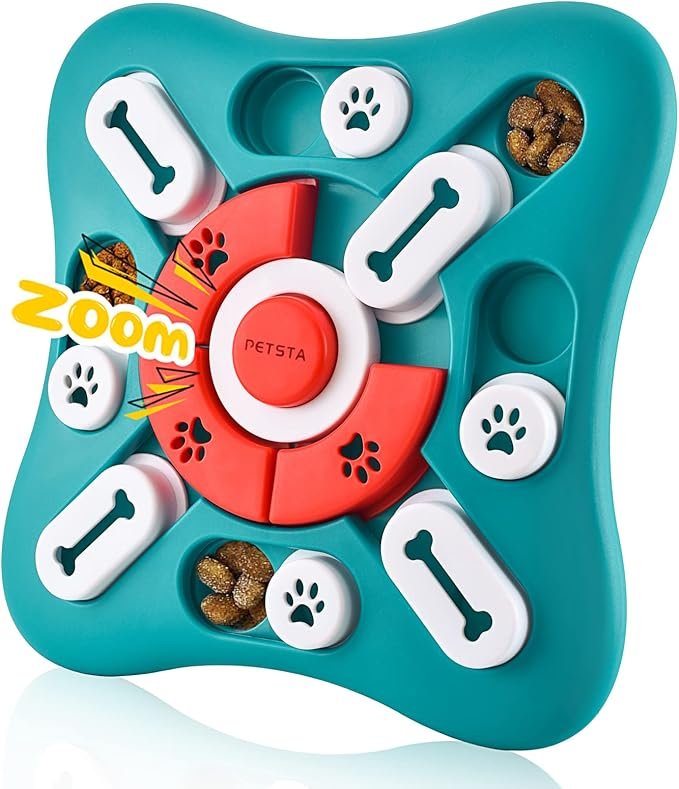
The PETSTA Dog Puzzle Toys, Treat Dispensing Dog Enrichment Toys for IQ Training and Brain Stimulation, Interactive Mentally Stimulating Toys as Gifts for Puppies, Cats, Dogs is made for that job.
Instead of giving your dog a treat right away, this puzzle makes the dog work for it.
The toy uses sliding and moving sections to hide food. Your dog has to sniff, push, move, and learn to find the reward.
It can also help turn normal feeding into a small brain game.
But is this PETSTA puzzle actually worth buying?
I looked closely at its design, features, ease of use, cleaning, difficulty, and common customer feedback to find out where it works best and where it may fall short.
PETSTA Dog Puzzle Toys Review
The first thing I like about this toy is the simple idea.
You put small treats or kibble into the puzzle. Your dog then has to figure out how to get them out.
That sounds easy.
For many dogs, it is not.
The challenge gives them a reason to slow down and pay attention.
The PETSTA puzzle is designed for puppies, cats, and dogs of different sizes. It can be used as a treat toy, enrichment toy, training tool, or slow-feeding option.
It is especially useful for dogs that enjoy food.
If your dog loves snacks, the reward gives the puzzle a clear purpose.
Design and Build Quality
The PETSTA puzzle has a flat design that sits on the floor.
This is important.
A puzzle toy is much more useful when your dog can work on it without pushing it across the room.
The base also has anti-slip support to help reduce movement during play.
The toy feels more like a brain game than a normal chew toy.
There are different sections where food can be hidden. Your dog needs to use its nose and paws to explore the toy.
The plastic construction is made for normal indoor play.
However, I would not treat this as a chew toy.
Dogs that aggressively chew plastic may damage it. They should be watched while using it.
That is one of the biggest things to keep in mind before buying.
Treat Dispensing
This is the main reason to buy the PETSTA puzzle.
You can hide small treats or pieces of kibble inside the openings.
Your dog then needs to discover where the food is and work out how to reach it.
This makes a normal snack more interesting.
It can also be useful during feeding.
Some dogs eat too fast. A puzzle can make them spend more time finding their food instead of finishing it in seconds.
The treat spaces work best with smaller kibble and small treats.
Large pieces may not fit well.
So, before filling the toy, check the size of your dog’s food.
Three Difficulty Levels
One feature that makes this puzzle more useful is the adjustable challenge.
The toy can be used at different difficulty levels.
This matters because dogs do not all learn at the same speed.
A beginner dog may need a very easy setup.
A smart or experienced dog may need something harder.
Starting easy also helps prevent frustration.
I would begin with treats that are easy to find.
Once your dog understands the basic idea, you can make the puzzle harder.
This creates a simple learning path.
The dog learns one action first.
Then you add more challenge.
That is better than giving a beginner a puzzle that feels impossible.
Mental Stimulation
This is where the PETSTA puzzle stands out.
Physical exercise is important for dogs.
But mental activity matters too.
A dog can have plenty of energy even after a normal walk.
A puzzle gives the dog another way to use that energy.
The dog needs to smell.
It needs to look.
It needs to remember what worked.
It needs to try again when something does not work.
That type of activity can make a short play session feel more meaningful.
It is also useful on days when you cannot spend as much time playing outside.
Of course, a puzzle toy is not a replacement for walks, exercise, training, or attention.
It is an extra activity.
And that is where I think this toy makes the most sense.
Is It Good for Puppies?
Yes, it can be a good choice for puppies.
Puppies are naturally curious.
They want to explore everything.
A food puzzle gives that curiosity a useful direction.
Instead of simply eating from a bowl, the puppy has to search for food.
It can also introduce basic problem-solving skills.
The key is to start simple.
Do not make the puzzle too difficult on the first try.
Show the puppy where the treats are.
Let it discover the reward.
Once it understands the game, increase the challenge slowly.
Is It Good for Adult Dogs?
It can be.
Adult dogs that enjoy food and games may get a lot from this puzzle.
It is especially useful for dogs that get bored easily.
It can also add variety to a normal daily routine.
However, very smart dogs may learn the puzzle quickly.
Some customer feedback suggests that experienced puzzle dogs can solve it in only a few minutes.
That is not necessarily a problem.
It simply means this toy may be better as an easy-to-medium puzzle than as a very difficult brain challenge.
If your dog already solves advanced puzzles, you may want something harder.
Does It Help With Fast Eating?
It can help slow down eating.
That is one of the useful side benefits of this toy.
Instead of placing food in a bowl, you can spread small amounts through the puzzle.
Your dog has to search for each piece.
That naturally takes more time.
Still, I would not depend on this toy alone for every meal.
Some dogs may solve it quickly.
Others may lose interest.
It works best when you choose the right food size and difficulty for your dog.
Is It Easy to Use?
Yes.
The basic idea is simple.
Put food inside.
Place the puzzle on the floor.
Let your dog investigate.
If your dog does not understand it, help a little.
Do not force the dog to solve it.
A good first session should feel like a fun game.
Once your dog understands that moving parts can reveal treats, the learning gets easier.
Some dogs understand the toy almost immediately.
Others need a few attempts.
That difference is normal.
Cleaning
Food puzzles need regular cleaning.
Small crumbs can collect inside the openings.
The good news is that this toy is designed to be easy to clean, and customer feedback commonly mentions dishwasher cleaning as a benefit.
Still, I would check the manufacturer’s current cleaning instructions before putting it in a dishwasher.
Regular cleaning is important.
Old food left inside a puzzle can become unpleasant and unhygienic.
I would also let the toy dry fully before storing it.
Noise and Squeaky Feature
The puzzle includes a squeaky center feature.
Some dogs may love this.
Dogs that enjoy squeaky toys may find the extra sound exciting.
It can make the puzzle feel more like a game.
But not every dog will care about it.
Some dogs may focus only on the treats.
Others may enjoy the sound as much as the puzzle.
So I would consider the squeaker a bonus rather than the main reason to buy this toy.
What Customers Like
A lot of customer feedback points to the same basic benefits.
Dogs enjoy searching for treats.
The puzzle can keep them busy.
It can slow down eating.
Many owners also like that it gives their dogs something mentally active to do indoors.
Another common positive is that the puzzle is not extremely difficult.
That makes it easier for beginners.
For a puppy or a dog that has never used a puzzle toy, that can be a big advantage.
What Customers Do Not Like
The biggest weakness is that some smart dogs solve it too quickly.
A dog that already understands puzzle toys may not find it challenging for long.
Another concern is chewing.
This is not a toy I would leave with an aggressive chewer.
Some customer feedback also mentions that small puppy-size kibble works better than larger adult kibble.
So food size matters.
Finally, some dogs may simply not care about puzzle toys.
If your dog is not very food motivated, the reward may not be strong enough to keep it interested.
PETSTA Dog Puzzle Toys Pros and Cons
Pros
- Great source of mental stimulation
- Treat-dispensing design
- Can help slow down eating
- Multiple difficulty levels
- Good for puppies and beginner puzzle users
- Works with small treats and kibble
- Flat design helps keep it stable
- Can provide indoor entertainment
- Useful for training and enrichment
- Easy to refill
- Easy to clean
- Squeaky feature adds extra fun
- Good option for food-motivated dogs
Cons
- May be too easy for very smart dogs
- Not suitable for aggressive chewers
- Large treats may not fit well
- Some dogs may need help learning it
- Food crumbs can collect in small spaces
- The squeaker may not interest every dog
- Not a replacement for exercise or outdoor play
Who Should Buy the PETSTA Dog Puzzle Toys?
I think this toy makes the most sense for a few types of pet owners.
Puppy Owners
If your puppy is new to puzzle toys, this can be a nice starting point.
The reward-based design gives the puppy a reason to explore.
Food-Motivated Dogs
This is probably the best match.
If your dog gets excited about treats, the food provides instant motivation.
Fast Eaters
The puzzle can turn quick eating into a slower activity.
It gives your dog more work to do for each small reward.
Bored Indoor Dogs
If your dog needs more things to do inside the house, this toy can add variety.
It gives the dog a simple mental task.
Owners Looking for Enrichment
If you want more than basic chew and squeak toys, this is worth considering.
It gives your dog something to solve.
Who Should Skip It?
I would look for another option if your dog is an aggressive chewer.
This is an enrichment puzzle, not a heavy-duty chew toy.
I would also skip it if your dog already solves simple puzzles very quickly and needs an advanced challenge.
And if your dog has little interest in treats, the main reward system may not work well.
How I Would Use the PETSTA Puzzle
I would start with the easiest setup.
Put a few small treats in easy-to-find spots.
Let your dog explore.
If it gets confused, show where one treat is.
Once your dog understands the idea, increase the difficulty.
You can also change where you place the food.
That prevents the routine from becoming too predictable.
I would keep the sessions short at first.
There is no need to make the dog use the puzzle for a long time.
The goal is fun and mental activity.
Not frustration.
I would also supervise the first few sessions.
This helps you see how your dog interacts with the toy.
It also lets you notice if your dog tries to chew or flip the puzzle instead of solving it.
PETSTA Dog Puzzle Toys Rating
Mental Stimulation: 4.5/5
Treat Dispensing: 4.5/5
Ease of Use: 4.5/5
Difficulty: 4/5
Cleaning: 4.5/5
Durability: 4/5
Value: 4.5/5
Overall: 4.4/5
Frequently Asked Questions
Is the PETSTA Dog Puzzle Toy good for puppies?
Yes. It can be a good beginner puzzle for puppies. Start with the easiest setup and use small pieces of puppy-safe food or treats.
Can cats use the PETSTA puzzle?
Yes. The design can also be used with cats, especially cats that enjoy food-based games and searching activities.
Does this puzzle slow down eating?
It can. The dog needs to search for small amounts of food instead of eating everything from a normal bowl at once.
Is the PETSTA puzzle good for large dogs?
It can work for many dogs, but the dog’s size and play style matter. A large dog that is an aggressive chewer may not be a good match.
Can aggressive chewers use this toy?
I would not recommend leaving an aggressive chewer alone with it. A determined chewer may damage the plastic.
What type of treats work best?
Small treats and small pieces of kibble work best. Very large treats may not fit into the food openings.
Is the puzzle difficult?
It has different difficulty options, so you can start easy and increase the challenge. Very smart dogs may still learn it quickly.
Does the toy make noise?
Yes. It includes a squeaky center feature. Some dogs may enjoy the sound, while others may ignore it.
Can it replace a slow-feeder bowl?
It can be used as another slow-feeding option, but it is not necessarily the best choice for every meal or every dog.
Is it dishwasher safe?
Customer feedback commonly mentions dishwasher cleaning, but I recommend checking the current manufacturer instructions before using a dishwasher.
Is this toy good for bored dogs?
Yes. It can give bored dogs a simple activity that uses their nose, paws, and problem-solving skills.
Can I leave my dog alone with this puzzle?
I would supervise your dog, especially during the first few sessions. Dogs that chew or try to flip toys may need closer watching.
Does every dog like puzzle toys?
No. Some dogs love food puzzles, while others lose interest. Food motivation and personality make a big difference.
Final Verdict
The PETSTA Dog Puzzle Toys are a simple way to add more mental activity to your dog’s day.
The biggest advantage is the combination of food and problem-solving.
Your dog does not simply get the treat.
It has to work for it.
The adjustable challenge also makes the toy useful for beginners.
Puppies can start with easy tasks. More experienced dogs can use harder setups.
I also like that the puzzle can help with slow feeding and indoor enrichment.
But it is not perfect.
Very smart dogs may master it quickly.
Large treats may not fit well.
And aggressive chewers should not be trusted with it unsupervised.
For the right dog, though, those issues are easy to understand.
If you want an affordable interactive toy that can turn treat time into a small brain game, the PETSTA Dog Puzzle Toys are a solid option.
My final rating: 4.4/5.
It is especially worth considering for puppies, food-motivated dogs, fast eaters, and dogs that need more indoor mental stimulation.